
Facilities and Equipment
As with all good things……..this setup has now undergone a major change, with the Soundcraft Sapphyre moving on to a new studio. When Tim (Studio Systems) decided to retire, seeking tranquility and inner-peace in his camper van, he left a legion of loyal customers (and friends) in tears! It’s an impossible vacuum to fill.
This section is a bit, but not overly, ‘tekky.’
The studio now has a live desk acting like a giant patchy with a digital interface and various other new pieces of gear.
This is a small private studio comprising two rooms, one for recording, overdubbing and sequencing, the other acting as a control room. A band can comfortably produce material for mastering.
The original desk was a dual-frame 24 channel desk, a Soundcraft Sapphyre, of vintage analogue pedigree. It even had Gates on every channel, which is a very unusual feature, and excellent EQ. There were six auxiliaries and six stereo inputs, allowing for plenty of flexibility. A 24-track Fostex digital machine still handles recording, with a range of monitors. Stereo mixes still go to DAT (tape adds something) & computer, simultaneously if needed. There are several FX units & pedals to mangle anything. There’s even an old Evans Echopet unit. Sadly, the Cry Baby died.
Sampling can be done on computer or by dedicated units. There are samplers from Akai, E-Mu & Yamaha.
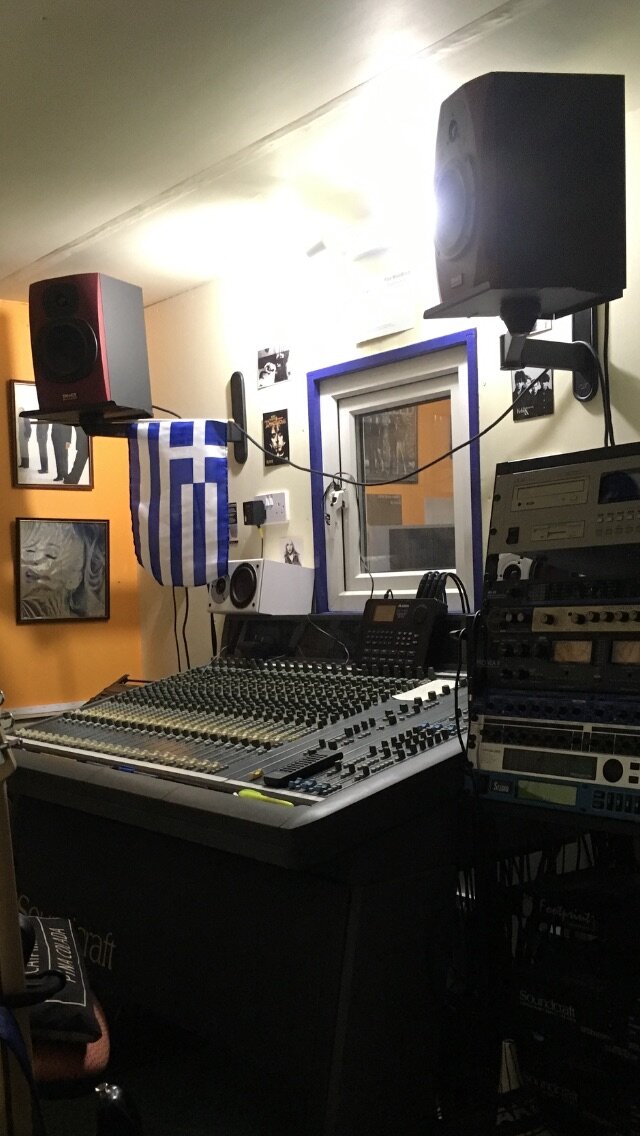

A view of the control room showing the original Sapphire in situ. That’s a rack set-up from years ago. The Samson amp died many moons hence. The Roland D110 really needed its own edit-controller to get the best out of it. Nice sounds, though. Not used much these days.
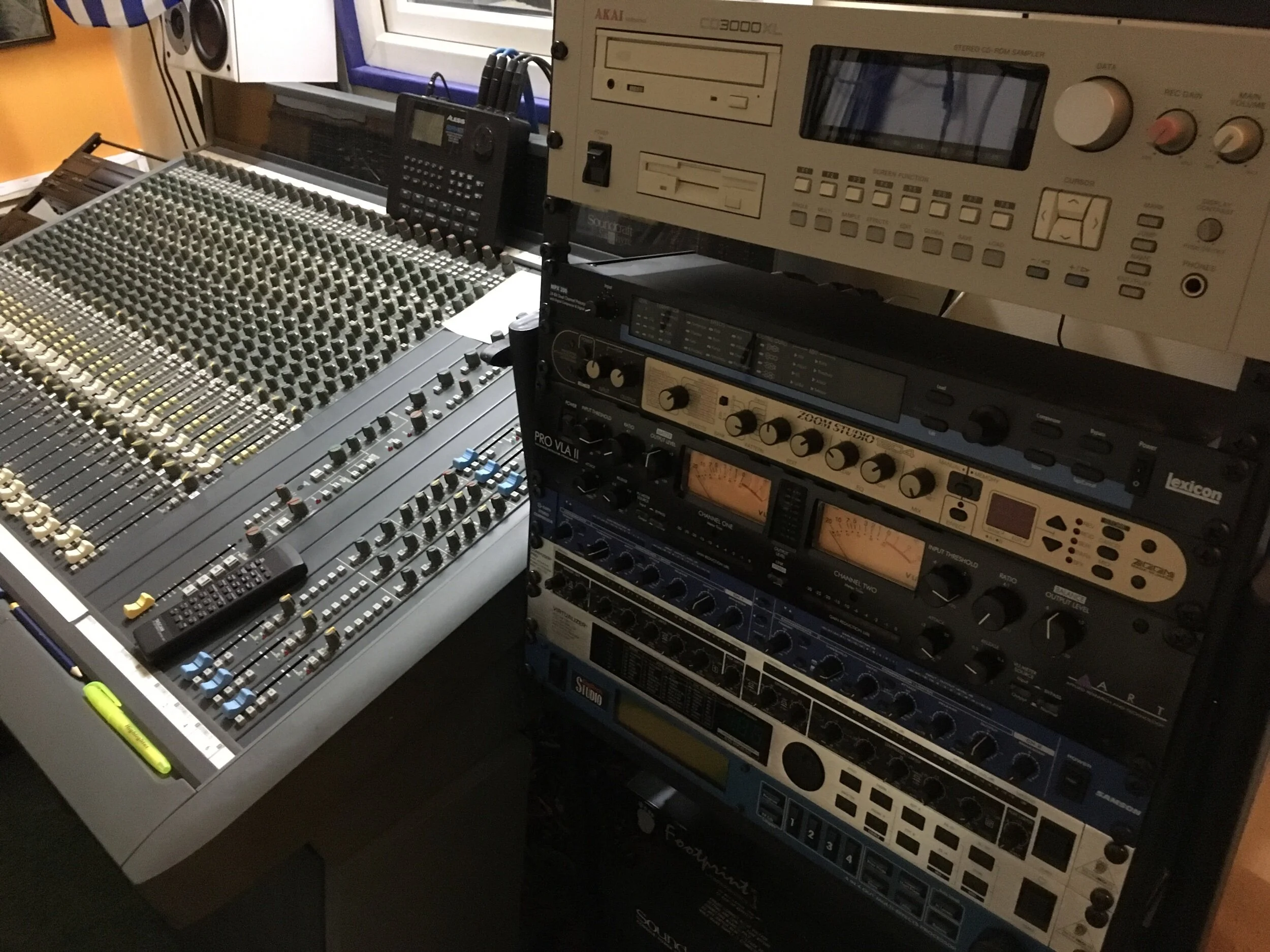
The rack has a number of FX units and a couple of bog-standard compressors. To compensate for the lack of groups on the newer desk, inputs 5-8 on the multi-track have been creatively patched through the compressors. They don’t even have to be powered. Tech, eh? It’s handy for light vocal or instrument compression on recording.
Of the FX units I must mention the Zoom. For its price it is unbelievable and has some wacky sounds. Recommend to anyone. Eno has the cheaper version in his rack! One of the best units is the Digitech Studio Quad. Fabulous sounds and quality for its age.
There are four groups of speakers in use, driven by Marantz and Omniphonics (Footprint) amps. There’s a back-up system, in case the Multi-track packs up. This is in the form of a Mac-based set-up with the latest MOTU 828 interface. Software includes Digital Performer & Ableton. Some of the functions of the software these days are mind-bogglingly magnificent, but I prefer playing with knobs.
I still send final mixes to DAT tape. The Tascam is brilliant. The sound is immaculate. I also send mixes to a computer, but the difference in playback is incredible. Tape has something special, particularly HHB. The DAT mixes go for mastering. Another pair of ears is essential as is the expertise.
The multitrack is a very reliable Fostex digital machine. It has 24 tracks at various sample rates. There are two drive ports, one 30 Gb on board for recording (there’s a spare back-up 160 Gb drive) and the second port is for DVD-RAM cartridges. They provide back-up of recordings in their multitrack format. Invaluable. You can even play back from the cartridges!
Finally, synthesisers. Awesome sounds are gifted by Korg, E-Mu (Ensoniq), Roland, Arturia & Modal. There are piles of instruments provided by software now, too, in the form of plug-ins. Anyone remember the North Pole Filter & Ray-Gun plug-ins for the beige G3 Macs? Amazing.


2nd photo: A Yamaha A3000 sampler. The sampler is a bit quirky, but has three banks of very very good effects. I often stick a Westone Thunder guitar through its Marshall stacks!
3rd photo: Here’s a mix compressor fired up. It has a ridiculous quality for its price. It’s an ART compressor. You’ll find them in huge studios with other compressors ten-times the cost. I find it produces nice vocal results with a 4:1 or 6:1 ratio. It can handle very aggressive ratios, but can also destroy electronic mixes. Awesome.
4th photo: It’s worth splashing a large amount of a budget on decent microphones. It pays dividends. It doesn’t matter which make. Just invest. There are some impressive condenser microphones about, as well as vintage types. A variety is sensible. Some of the cheaper ‘copies’ are ridiculously good.


Pictured left above is an EMU 4000 sampler, loaded with the additional FX board. On the right is the back room from several years ago, used for sequencing with the trusty old G3 Mac. The Mac had a ‘massive’ (tongue-in-cheek) 4Gb drive, partitioned into two 2Gb drive areas, one for Programs & the other for audio. 4Gb! and, remarkably, that was sufficient in the mid-90s. There are still some fantastic programs on it, such as Bias Peak, on which Toy Story was made.
The room doubles as a vocal booth, a dead space, also used for recording acoustic & semi-acoustic instruments (through DI units and compressors) and a neat place for adding electric guitar parts. There are many options for guitar overdubbing. Monitoring in there is good, too, with headphone & speaker foldback.


Always useful to have a variety of guitars. Nothing worse than sending a guitarist into a guitar shop!
Pictured above are a Les Paul Standard Gibson from Nashville & an odd, but nifty, Vantage Resonator guitar, which is great for unusual tunings or a bit of slide (though you’d probably want to change the action for true slide playing).
I’ve had this semi-acoustic Burns guitar for many years. I picked it up as a bargain in Birmingham in 1974. Baldwin-Burns were quite popular in the mid-60s & you occasionally see them for sale. Looks nice and plays great. This was the ‘tobacco’ model, complete with James Burns pick-ups.
A very nice blue semi-acoustic, from Freshman’s Apollo range. Has gold tuning gears. Sounds good when DI’d into the desk. There are other guitars, both acoustic and electric (e.g. Westone, Harley Benton, Fender, PRS & Dean). Pre-amp is provided by Palmer and the wonderful Black Lion.
